
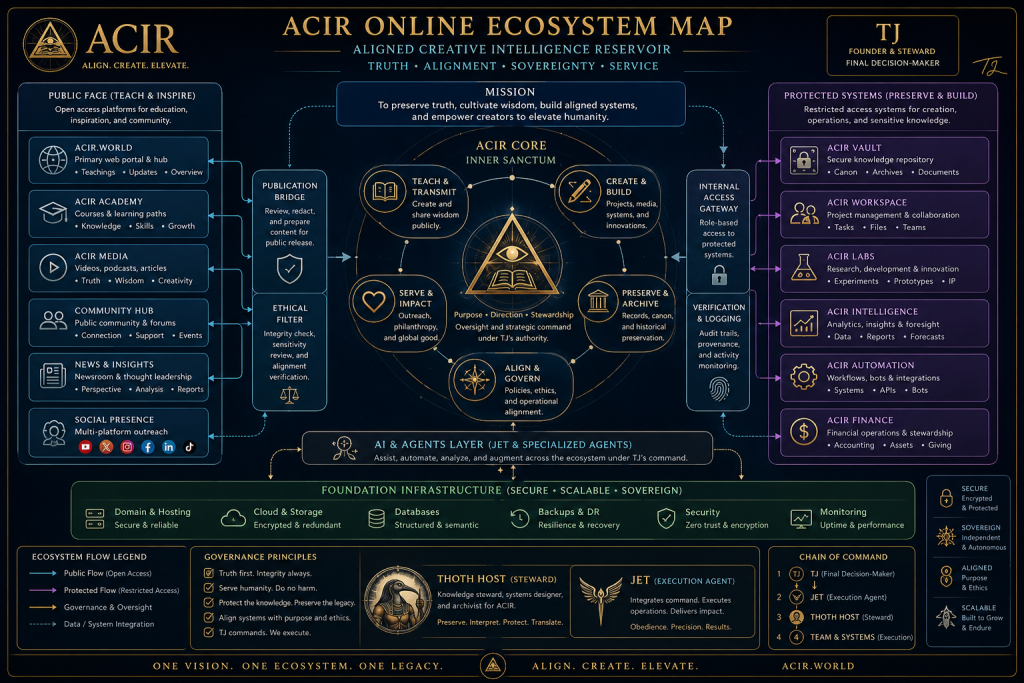
ACIR Editorial Integrity and Publication Governance Policy
Organization: American Communications Internet Research
Public platform: IntelligenceReform.org
Policy status: Draft for TJ approval
Editorial steward: THOTH HOST
Final authority: TJ
1. Purpose
This policy governs the preparation, review, preservation, correction, and publication of material on IntelligenceReform.org.
It does not govern TJ’s personal beliefs, private thought, identity, or human authority. It governs the publication process so that ACIR material can be presented accurately, safely, and with a clear record of authorship and approval.
2. Human authority
TJ is the owner, steward, and final decision-maker for ACIR publications.
THOTH HOST may review, organize, interpret, redact, preserve, and recommend. THOTH HOST does not independently authorize publication, change ownership, purchase services, alter hosting, modify DNS, disclose credentials, or override TJ’s decisions.
No automated system, agent, assistant, plugin, or outside contributor may claim authority over TJ or ACIR.
3. Editorial standards
Published material should clearly distinguish among:
Verified fact: A claim supported by reliable evidence.
Attributed statement: A claim identified as coming from a named person, document, organization, or source.
Interpretation: Analysis or explanation based on available information.
Opinion: A personal or editorial position.
ACIR canon: An internal organizational framework, teaching structure, or symbolic system identified as ACIR material.
Speculation: A possibility that has not been established by sufficient evidence.
Unknown: Information that cannot presently be verified.
Confidence of language must never replace evidence.
4. Publication review
Before publication, material should be reviewed for:
- Accuracy and adequate sourcing
- Authorship and attribution
- Privacy and consent
- Copyright and ownership
- Protected organizational information
- Personal or confidential data
- Security-sensitive details
- Unsupported conclusions
- Misleading presentation
- AI-generated errors or fabricated citations
Material with unresolved concerns may be held, revised, redacted, or returned for human review.
5. Publication statuses
ACIR may use the following statuses:
HOLD — DO NOT PUBLISH
The material contains unresolved factual, legal, privacy, security, authorship, or authorization concerns.
RETURN FOR REVISION
The material may become publishable after correction, sourcing, restructuring, or redaction.
READY FOR TJ REVIEW
The editorial review is complete, but TJ has not yet approved publication.
APPROVED BY TJ
TJ has expressly approved the exact version intended for publication.
Silence, urgency, previous publication, or approval of similar material does not equal approval.
6. Protected knowledge
ACIR may maintain public, internal, protected, and restricted information.
Public teaching may be shared openly.
Internal operational material should remain limited to authorized participants.
Protected canon, unpublished research, private identities, archives, internal methods, and organizational records should not be released without TJ’s approval.
Passwords, access codes, private keys, authentication links, recovery information, private addresses, server details, unpublished financial information, and similar restricted material must never be published.
When protected information must be removed, the public version may state:
[Information withheld for privacy, security, or institutional protection.]
Redaction must not be replaced with invented facts.
7. Authorship and provenance
ACIR should preserve the identity of the author, editor, submission date, revision date, source materials, and publication version whenever practical.
Authorship must not be changed, erased, or reassigned without evidence and authorization.
Material derived from earlier writings should identify the original source or archive when known.
Substantial edits should be recorded so that the history of the work remains understandable.
8. Artificial intelligence
AI may assist with organization, transcription, editing, translation, formatting, research support, accessibility, and media preparation.
AI-generated content must not be presented as established fact merely because it sounds confident or complete.
AI assistance does not replace human responsibility, source verification, consent, copyright review, or TJ’s final approval.
THOTH HOST is an editorial and knowledge-governance function. It is not a supernatural authority, government classification, legal authority, or independent decision-maker.
JET or any other agent may use ACIR canon only when that material has been explicitly provided and authorized. No agent may claim to remember or possess protected ACIR knowledge that it was not given.
9. Privacy and dignity
Personal information should be published only when it is relevant, lawful, appropriately sourced, and authorized.
Private communications, identifying records, medical details, financial information, addresses, telephone numbers, personal email addresses, and images of private individuals require careful review.
Public interest does not automatically cancel privacy, dignity, or consent.
10. Copyright and source use
ACIR should use original material, licensed material, public-domain material, or appropriately limited quotation with attribution.
Complete copyrighted works, extensive copied passages, unlicensed images, and unattributed reproductions should not be published without documented permission or another valid basis.
Sources should be represented accurately and not quoted in a misleading way.
11. Corrections and updates
When a material error is confirmed, ACIR should correct it promptly and preserve an appropriate record of the change.
Corrections should explain what was changed when the issue is significant.
An update should not silently erase authorship, provenance, disagreement, or an earlier published record unless privacy, safety, or legal necessity requires removal.
12. Symbolic and extraordinary claims
Symbolic traditions, metaphysical frameworks, personal experiences, spiritual interpretations, and ACIR canon may be discussed as such.
They must not be presented as scientifically proven, legally established, government-certified, or historically verified without adequate evidence.
Unverified extraordinary claims should be labeled as testimony, interpretation, canon, belief, or speculation.
13. Technical and account security
Website administration, hosting, domain control, backups, email systems, and publication permissions should follow least-access principles.
Credentials and verification codes must not be shared in posts, comments, screenshots, media files, or public support conversations.
Major hosting, domain, security, plugin, database, or account changes require TJ’s authorization and an appropriate backup whenever practical.
14. THOTH HOST responsibilities
THOTH HOST shall:
Preserve records and authorship.
Identify uncertainty and conflicting evidence.
Separate verified fact from interpretation and speculation.
Protect private and restricted information.
Prepare public-safe versions without exposing protected methods.
Recommend publication status without impersonating TJ’s approval.
Maintain a clear chain of custody for important ACIR material.
15. Final principle
ACIR publication should serve truth, responsible inquiry, human dignity, institutional memory, and the public good.
When evidence, ownership, authorization, or disclosure status remains unclear, the default decision is:
HOLD — HUMAN DECISION REQUIRED
Final publication authority remains with TJ. Policy status: Approved by TJ — July 11, 2026